When you’re growing a business, a website involves many moving parts, with SEO being one of them. Understanding what SEO means today and where it fits in the value chain can help your website reach the right audience and grow its visibility at scale.
You invest in building the website pages, creating content and designing experiences for your users, then continuously measure performance to understand whether they’re reaching the actions that matter. But amid all this, where does search engine optimisation fit in? It is often treated as an afterthought, a marketing activity focused on driving reach to a website that has already been built. But modern SEO is much more than that. It sits at the heart of building a website, because for your experience to reach the right people at scale, search engines first need to understand what your website offers.
Google sees a website differently from your users. Before Google can show a website to someone searching for a product, service, answer, or piece of information, it needs to understand what your website is, what each page is about, whether those pages should be included in its index, and whether they are relevant and useful for a particular search.
This is where SEO comes in. It is often treated as a checklist of keywords, meta titles, backlinks, and technical fixes, but it is much broader than that. At its core, it’s about making it easier for search engines to discover, understand, evaluate, and ultimately surface your website to the right audience. And that does not happen in isolation. Making a website discoverable depends on how clearly the content communicates, how easily people can navigate the experience, how well the website is structured and how effectively the underlying engineering allows search engines to access and understand it.
Content, user experience and engineering all need to come together. So, what exactly does Google need, to understand your website?
SEO starts with engineering: Can Google find and access your website?
Before Google can understand your content or evaluate the experience, it first needs to access the website.
The first question is simple: Can Google find your website and its pages?
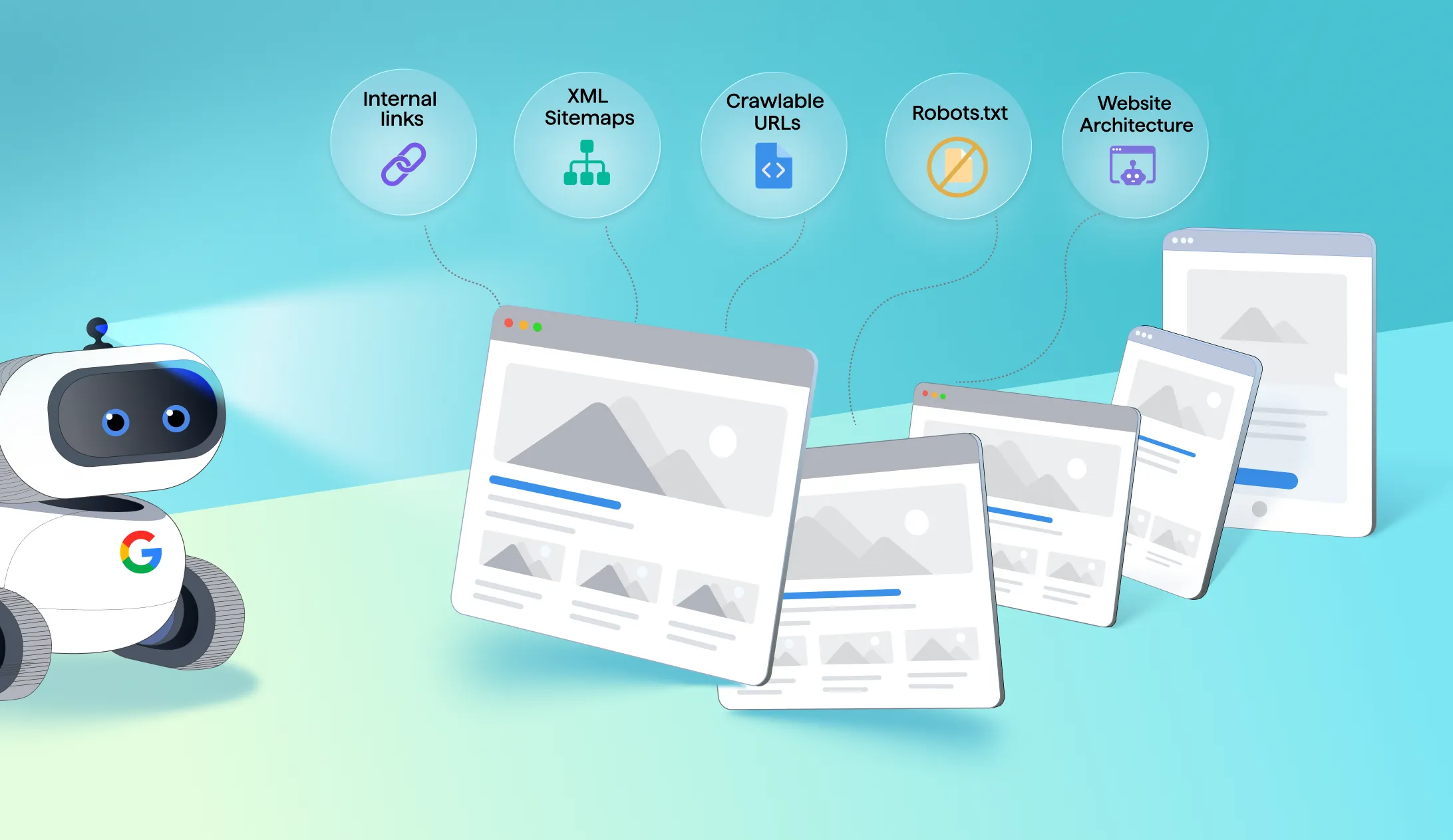
Search engines use automated systems, commonly called crawlers, to discover pages across the web. They follow links from one page to another and use sources such as sitemaps to discover URLs. If an important page cannot be discovered, everything else becomes irrelevant. This is why basic technical SEO elements are important:
- Internal links
- XML sitemaps
- Robots.txt
- Crawlable URLs
- Proper website architecture
Content, even the most impressively written, has very little opportunity to appear in search results if search engines cannot reach a page.
Content gives Google context: What is your page actually about?
Once Google can access a page, it needs to understand it. Imagine a page on a website with a large image, a few buttons, and a heading that simply says, "Learn More.” A human visitor might understand the context because of the surrounding design. A search engine needs more information.
The content and structure of a page help Google understand its subject. This can include:
- Page titles
- Headings
- Body content
- URLs
- Internal links
- Image alt text
- Structured data
- Relevant metadata
For example, compare these two page titles: "Our Services" and "Digital marketing services for growing businesses". The second title gives considerably more context about what the page is about. This does not mean every page should be stuffed with keywords. Instead, the goal is to make the subject and purpose of the page clear.
Content & engineering help Google decide whether pages should be indexed
Being discovered does not automatically mean a page will appear in Google Search. This is where concepts such as indexing, canonical URLs, duplicate content, and directives become important. For example, a website might have several URLs that display essentially the same content.
Google needs to understand: Which version is the primary page?
This is one reason technical SEO matters. A well-designed website can still create confusion for search engines if it generates large numbers of duplicate, inaccessible, or unnecessary URLs. The goal is not to get every URL on your website indexed. The goal is to make sure that the right pages are available to search engines.
How do people search on Google?
Now we move beyond the website itself. Google isn't just trying to understand your page. It is also trying to understand the search query. Consider someone searching for: "best running shoes” versus: "how to clean running shoes"
The topic is similar, but the intent is completely different. The first searcher may be looking for products or recommendations. The second is looking for information. This is known as search intent. A page can be technically perfect and still struggle to perform if it does not satisfy the intent behind the search. This is why SEO isn't simply about choosing a keyword and putting it on a page. The more important question is: What does someone searching for this query actually want to find?

Is the content worthy to be indexed?
Once Google understands what your page is about and what a searcher is looking for, it needs to evaluate whether the content is useful for that search. This is where content quality becomes important. Good SEO content isn't necessarily the longest content. A 3,000-word article isn't automatically better than a 700-word article. What matters is whether the page effectively addresses the user's needs. Useful content might:
- Answer a specific question
- Explain a complicated topic clearly
- Help someone make a decision
- Provide original information
- Solve a problem
- Offer useful examples or evidence
- Make the next step clear
The objective should therefore not be: "How much content can we put on this page?”. It should be: "How well can we answer the user's question?”.
Is the content genuine?
Search results are ultimately about helping users find reliable and useful information. Google therefore considers many signals when determining which pages should appear prominently for a query. These can include the quality and relevance of the content, the reputation of the website and content creators, references and links from other websites, and other signals associated with the overall quality of a result.
This is one reason SEO extends beyond what happens directly on your website. For example, another reputable website linking to your content can provide an important external signal.
On the other hand, a hundred irrelevant links do not automatically make a website more trustworthy than a handful of genuinely relevant references. The broader principle is much simpler: Build something worth referencing, sharing, and trusting.
User experience answers another question: Can people actually use the website?
Search engines don't exist independently of users. If a website is extremely slow, difficult to navigate, unusable on mobile devices, or constantly interrupted by intrusive elements, it creates a poor experience for visitors. This is when user experience, engineering, and modern SEO begin to overlap.
Consider two websites offering essentially the same information. One loads quickly, works well on a mobile, has clear navigation, and makes it easy to find information. The other takes several seconds to load, has broken layouts on mobile, and makes visitors search through multiple pages to find basic information. From a user's perspective, the difference is obvious. From an SEO perspective, a website is a part of the larger picture; a discoverable website still needs to be usable once someone arrives.
The following areas can all contribute to creating a better experience:
- Mobile usability
- Page performance
- Core Web Vitals
- Navigation
- Accessibility
- Clear page structure
SEO is not a standalone activity. Content helps search engines understand the website, user experience helps people navigate and use it, while engineering ensures the website can be accessed, crawled and perform effectively.

Understand how your website fits together
A website structure tells Google and users how different pieces of information relate to each other. For example, imagine a website selling cameras. You might have: Cameras → Mirrorless Cameras → Full-Frame Cameras → Product Page
Internal links between these pages help establish relationships between topics and pages. A logical website structure makes it easier for users to navigate and helps search engines understand the hierarchy and relationships within the site. This is where internal linking becomes more than just a way to send visitors from one page to another. It can help communicate: "These pages are related, and this is how they fit together.” This is why website architecture, UX and SEO are part of the same conversation.
So, what does Google actually need to understand?
At a high level, Google needs answers to several questions. When these pieces work together, Google has a much clearer understanding of your website.
Google cannot be tricked
One of the biggest misconceptions about SEO is that it is about finding a loophole in Google's algorithm. The reality is much less complicated. Search engines want to provide users with the most useful results for their queries. Website owners want their websites to be discovered by the people who need what they offer.
Good SEO sits between these two objectives. Instead of asking: "What can I do to make Google rank my website?", a better question is: "What does Google need to understand about my website so that it can confidently show it to the right person?"
That shift in perspective changes how you approach SEO.
The bigger picture
A website has to pass through several stages before it can realistically compete for visibility in search.
Discover → Crawl → Understand → Index → Evaluate → Match with Search Intent → Rank
There isn't a single SEO action that guarantees visibility. Instead, SEO is about reducing the uncertainty between your website, the search engine, and the person searching. Can Google find the page? Can it understand the page? Can it determine what the page is useful for? Does the page satisfy the searcher's intent? Does the website provide a good experience? Does the content provide enough value and quality to deserve visibility?
The better your website answers these questions, the easier it becomes for search engines to understand where and when your website belongs in search results.
The final thought
Your website is designed for people, but search engines are often the gateway through which those people discover it. You don't need to build a website for Google. You need to build a website that Google can understand and people can use.
And that means SEO cannot be an isolated checklist. Content, user experience and engineering all have a role to play in making a website truly discoverable.